


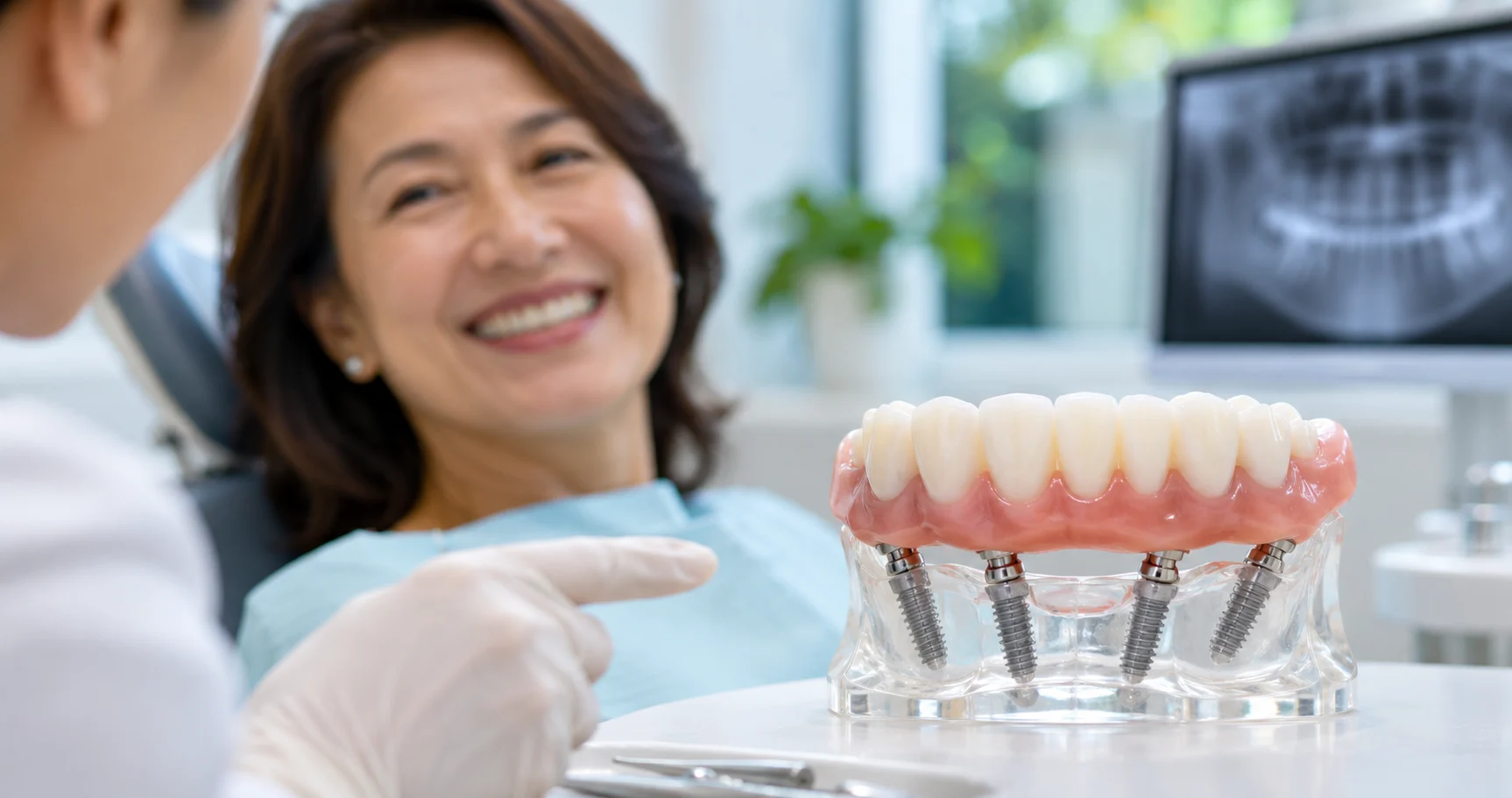


Losing most or all of your teeth affects everyday things like eating, speaking and smiling. Conventional dentures suit some people, but others would rather have something fixed in place. All-on-4 dental implants are one way to replace a full arch of teeth using four carefully positioned implants.
Before you commit, it helps to understand the treatment stages, the recovery period and the long term care involved. The plan and the results will always depend on your oral health, your jawbone and your individual needs, so treat this guide as a starting point for your consultation.
What Are All-on-4 Dental Implants?
All-on-4 dental implants replace most or all of the teeth in the upper or lower jaw. Four implants support a fixed bridge that covers the whole arch.
Typically, two implants go in towards the front of the jaw and two are angled towards the back. The angle makes better use of the bone that is available, which is why All-on-4 treatment can sometimes avoid extensive bone grafting. Some patients still need extra procedures, depending on their clinical condition.
Unlike a removable denture, an implant supported bridge stays in your mouth. The aim is to restore chewing, speech and the look of your teeth.
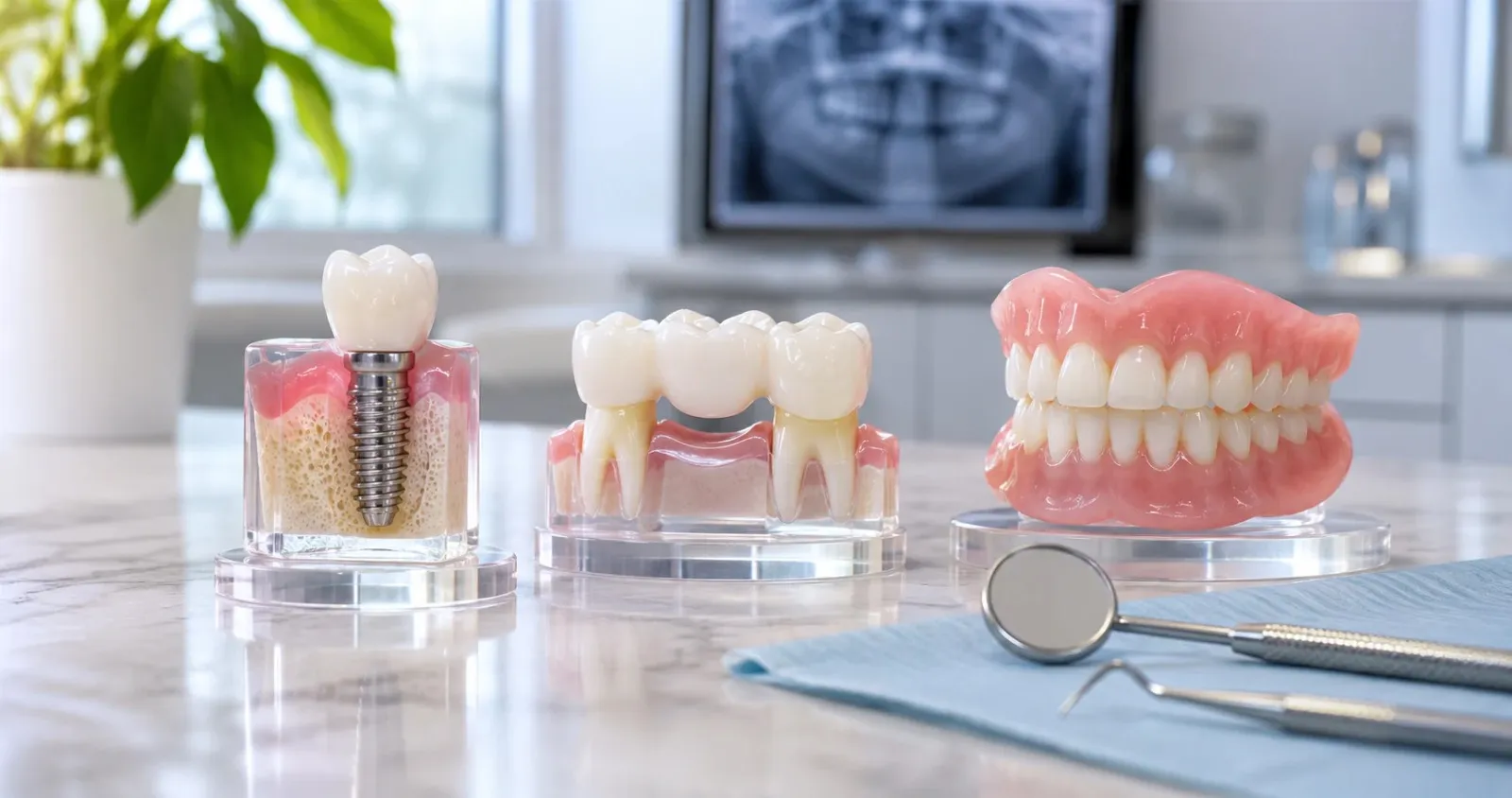
If you are weighing up tooth replacement more broadly, our guide to dental implants, bridges and dentures compares the main options side by side. Patients with extensive damage or tooth loss in both arches may also hear about full mouth rehabilitation, which plans treatment for multiple damaged or missing teeth together.
How Is All-on-4 Different From All-on-6?
All-on-6 follows the same idea but uses six implants instead of four. A dentist may suggest it when the jawbone needs more support or the bite puts extra load on the bridge. The right number of implants comes down to your bone, your bite and the type of bridge being planned, so it is something to settle at your assessment rather than choose in advance.
Who May Be Suitable for All-on-4 Dental Implants?
All-on-4 may be considered if you:
- Have lost most or all of the teeth in one or both jaws.
- Have several teeth that cannot be saved and may need to be extracted.
- Struggle to keep conventional dentures stable.
- Want a fixed alternative to removable dentures.
- Have enough bone in the right areas of the jaw to support the implants.
It is not right for everyone. Gum disease, uncontrolled diabetes, smoking, some medications and other medical conditions can affect healing and how well implants last.
Your dentist will assess your teeth, gums, jawbone and medical history before recommending treatment. If you have gum disease, it usually needs to be controlled first, and our guide to preventing gum disease explains why healthy gums matter so much for implants. You can also read about implant and peri-implant surgery procedures to see how gum and bone health fit into implant planning.
Other options may come up too, including conventional dentures, implant supported dentures or a different implant arrangement. If dentures turn out to suit you better, Alpha Dental Group offers dentures as a treatment in its own right.
What to Expect During All-on-4 Dental Implant Treatment
Treatment usually runs in several stages, from the first assessment through to your final bridge.
1. Initial Consultation and Assessment
Your treatment starts with a detailed examination. Your dentist reviews your medical history, listens to your concerns and checks the condition of your teeth and gums.
Imaging is usually needed to judge how much good quality jawbone you have. A three dimensional cone beam computed tomography scan, known as a CBCT scan, shows the teeth, jawbone and surrounding structures in 3D, and digital scans help plan where each implant should sit.
This is also the time to ask about the proposed treatment, the risks, the alternatives, the expected cost and the likely timeline. Good questions to bring include how many appointments to expect and what happens if healing is slower than planned.
2. Treatment Planning and Preparation
Once the assessment is done, your dentist builds a plan around your needs.
If some of your remaining teeth are badly damaged, they may need to come out. A tooth that can still be saved may not need extracting at all, and root canal treatment is sometimes an alternative to removal.
Gum disease may need treatment before implants go in. Where there is not enough bone, procedures such as a sinus lift or bone augmentation may be recommended first.
The All-on-4 technique can cut down the need for major bone grafting in selected cases, but it does not remove that need for everyone. Your dentist will tell you whether any preparatory work applies to you.
3. Implant Placement
During surgery, the implants are placed into the jawbone under suitable anaesthesia. The exact arrangement depends on how complex the case is and what your plan says.
After placement, the implants need time to bond with the surrounding bone, a biological process called osseointegration. It is what gives the implants their stability.
The number and position of the implants, the quality of the bone and how stable the implants feel at the end of surgery all shape the next stage. Your dentist will explain the expected healing period and any temporary changes to your diet.
4. Temporary Bridge and Final Teeth
In suitable cases, a temporary fixed bridge can be attached on the day of surgery or soon after. This is called immediate loading, and you can read more about the same day implant bridge service.
It is not guaranteed for every patient, though. Whether you can have it depends on how stable the implants are, the quality of your bone and the overall clinical picture. A temporary bridge is also designed for the healing period, so it may feel and function differently from your final teeth.
Once healing is far enough along, your dentist arranges your final custom made bridge. Timing varies from person to person.
Digital tools often play a part here. Alpha Dental Group describes its advanced dental technology, including digital impressions and the design and milling of restorations, and your dentist can explain which of these apply to your treatment.
What Is Recovery Like After All-on-4 Surgery?
Recovery differs between patients. Some swelling, bruising, tenderness and light bleeding are common in the early days.
Your dentist will give you specific instructions for managing discomfort and looking after the surgical sites. You may be advised to:
- Eat soft foods and avoid hard or chewy foods while the implants heal.
- Follow your medication and oral hygiene instructions.
- Avoid smoking, which can interfere with healing.
- Rest and limit strenuous activity as advised.
- Attend all of your follow up appointments.
Keep following your dentist's advice even when a temporary bridge is in place. The implants are still bonding with the bone, and too much pressure while they heal can affect the result.
Contact your dental team if you have increasing pain, bleeding that will not stop, worsening swelling, fever or anything else that concerns you. Regular dental check ups and preventive care also let your dentist keep an eye on your mouth during recovery and after the final bridge is fitted.
How Should You Care for All-on-4 Dental Implants?
Good oral hygiene matters just as much after implant treatment. The replacement teeth cannot decay, but the gums and bone around them can still become inflamed or infected.
To look after your implant supported bridge:
- Brush twice a day with a suitable toothbrush.
- Clean carefully underneath the bridge with the aids your dentist recommends.
- Use interdental brushes or a water flosser if you are advised to.
- Keep up regular check ups and professional cleaning visits.
- Report any looseness, discomfort or change in your bite.
A bridge can wear or need maintenance over time, so regular monitoring lets your dentist check the implants, the surrounding tissues and the restoration. Patients with a history of gum disease may need closer follow up. Our article on how long dental implants last covers what affects their lifespan, and these oral hygiene tips are a useful daily reference.
How Much Do All-on-4 Dental Implants Cost in Singapore?
There is no single price for All-on-4, because the fee reflects your own treatment plan. The number of arches being treated, the type of bridge, any extractions or bone procedures beforehand and the imaging you need all influence the final figure.
Ask for a written breakdown at your consultation so you can see what is included. It is also worth asking whether any part of the treatment qualifies for MediSave or another scheme. Our guide to MediSave and CHAS dental subsidies explains how these schemes work, and the clinic team can confirm what applies to you.
What Are the Possible Risks and Limitations?
All-on-4 involves surgery, so it is important to understand the risks before you go ahead.
Possible complications include infection, delayed healing, implant failure, nerve injury, sinus problems in the upper jaw and issues with the bridge or your bite.
The treatment also asks for careful daily cleaning and ongoing professional care. Some patients need extra treatment before the implants can be placed, and others need their plan adjusted if healing does not go as expected.
Not enough bone, uncontrolled gum disease and certain medical or lifestyle factors can all affect suitability. Your dentist can explain how the risks and limitations apply to your situation.
All-on-4 Dental Implants at Alpha Dental Group Singapore CBD
At Alpha Dental Group, patients thinking about replacing a full arch of teeth can talk through their concerns and treatment options with the dental team.
The clinic is at 20 Cecil Street in Singapore's CBD. It offers dental implant treatment and uses imaging to help with implant assessment and planning where it is indicated.
If you are dealing with extensive tooth loss or a denture that never feels secure, a consultation can show whether All-on-4 or another tooth replacement option makes sense for you. The team will explain the proposed stages, recovery, maintenance and expected costs before you decide anything.
Frequently Asked Questions on All-on-4 Dental Implants
Are All-on-4 dental implants painful?
Surgery is done under suitable anaesthesia, so discomfort during the procedure is managed. Some pain, swelling and bruising can follow afterwards. Your dentist can advise on pain relief and aftercare for your case.
Can I get new teeth on the same day as implant surgery?
Some patients can have a temporary fixed bridge on the day of surgery, but it depends on implant stability, bone quality and other clinical factors. Your dentist will tell you whether immediate loading is suitable for you.
How long does All-on-4 treatment take?
The surgery itself may be done in one appointment, but the whole process takes longer because the implants need time to bond with the jawbone before the final bridge is fitted. The timeline varies between patients.
Is bone grafting necessary for All-on-4 implants?
Not always. The positioning of the implants makes use of the bone you already have, which can reduce the need for grafting in selected cases. Some patients still need extra procedures depending on their bone, and a scan helps your dentist assess this during planning.
How do I maintain All-on-4 dental implants?
Brush twice a day, clean underneath the bridge with the aids your dentist recommends and attend regular appointments. Your dentist will suggest a cleaning routine and professional maintenance schedule that suits your mouth.
Are All-on-4 dental implants suitable for everyone?
No. Suitability depends on your oral health, available bone, medical history and anything else that could affect healing. Your dentist will discuss whether All-on-4, another implant approach or conventional dentures is the better fit.
What is the difference between All-on-4 implants and conventional dentures?
All-on-4 uses implants to hold a fixed bridge, while conventional dentures are removable. Each has different treatment requirements, upkeep and limitations, and your dentist can help you compare them.
What is the difference between All-on-4 and All-on-6?
All-on-4 uses four implants per arch and All-on-6 uses six. Six implants may be suggested when the jaw needs additional support. Your dentist decides based on your bone and bite.